
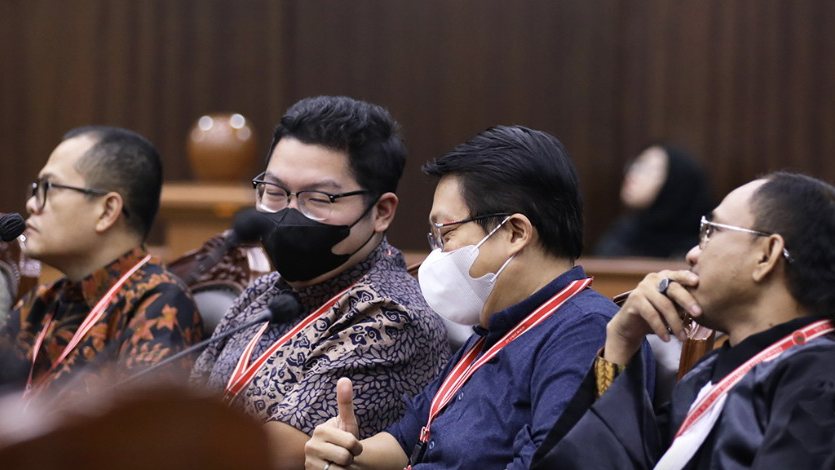
When the Constitutional Court of the Republic of Indonesia handed down Decision No. 144/PUU-XXI/2023 on 30 July 2024, the response from the international trademark bar was swift and uneasy. One leading regional firm published its analysis under the heading that the ruling risked far-reaching consequences. Another called it a double-edged sword. The European IP Helpdesk relayed the warning to businesses across the EU.
The concern behind that reaction is legitimate and deserves a direct answer rather than a dismissal. If Indonesia had made it harder to dislodge a squatter sitting on a global brand, foreign rights holders would be right to worry.
That is not what the decision did.
This page sets out the three propositions that, taken together, explain that case. We acted as counsel in it. What follows is not commentary on someone else’s litigation.
The holding, in full
The Court granted the petition in part. In Article 74(1) of Law No. 20 of 2016 on Marks and Geographical Indications, the phrase “3 (three) years” was declared contrary to the 1945 Constitution and without binding force unless read as “5 (five) years”. In Article 74(2)(c), the phrase “similar prohibitions” was held to lack binding force unless read to include force majeure conditions as governed by Government Regulation. Article 74(3) was left intact.
Nothing else in the Trademark Law was altered.
Proposition One
A trademark is a sign used in trade. We never argued otherwise.
The use requirement is not a policy bolted onto trademark law. It is what distinguishes a trademark from a reservation. Indonesian law says so in its opening definition:
“A Mark is a sign capable of being represented graphically — a drawing, logo, name, word, letter, numeral, arrangement of colours, in two or three dimensions, sound, hologram, or a combination thereof — used to distinguish goods and/or services produced by a person or legal entity in trading activities concerning goods and/or services.”
Law No. 20 of 2016, Article 1(1) — emphasis addedA sign that distinguishes nothing in the market distinguishes nothing at all. A registrant who files and then does nothing holds a certificate, not a mark. On this we hold the orthodox position, and we held it in argument.
Decision 144 did not abolish Article 74. It did not create a right to warehouse registrations. It did not convert the Indonesian register into a parking lot. Cancellation for non-use remains available to any interested third party, before the Commercial Court, on precisely the ground it always rested on.
What moved was the window: from three consecutive years to five, with force majeure added to the list of circumstances that excuse interruption. That is a calibration of how quickly commercial dormancy ripens into forfeiture. It is not a licence to be dormant.
The Court’s own reasoning makes the calibration point plainly. It observed the mismatch between a ten-year term of protection and a three-year forfeiture threshold, and it noted that the TRIPS Agreement sets three years as a minimum rather than a ceiling. Members may set a longer period. The European Union and the United States both operate on five. Indonesia moved toward that convergence, not away from it.
Proposition Two
The door that stops squatters was never Article 74, and it is still wide open.
Here is where the international commentary went wrong, and it went wrong on a point of doctrine rather than of policy.
The Trademark Law provides two separate routes against a registration. They rest on different grounds, address different wrongs, and carry different limitation regimes. Decision 144 travelled down one of them and never approached the other.
Article 74
Wrong addressed: what the owner did after registration.
Ground: the mark has not been used in trade.
Clock: five consecutive years, after Decision 144.
Excuses: import prohibition, temporary regulatory restriction, force majeure.
This is the only route Decision 144 touched.
Article 76 with Articles 20 and 21
Wrong addressed: what the applicant intended when filing.
Ground: conflict with a well-known mark, or an application made in bad faith.
Clock: five years from registration under Article 77(1) — but no limitation at all where bad faith is present, under Article 77(2).
Decision 144 did not alter a single word of this route.
The statutory language on the second route is unambiguous:
“An application shall be refused if it is filed by an Applicant acting in bad faith.”
Law No. 20 of 2016, Article 21(3)“A cancellation action may be brought without any time limit where there is an element of bad faith and/or where the Mark concerned conflicts with the state ideology, statutory regulations, morality, religion, decency, or public order.”
Law No. 20 of 2016, Article 77(2) — emphasis addedA squatter’s registration is defective from the moment it is filed. That defect does not cure with time, and Indonesian law expressly refuses to let it. The brand owner who discovers a hijacked mark in year eight stands in the same position as the one who discovers it in year two.
A practical consequence worth more than the doctrine
Suing a squatter for non-use was always the weaker instrument, quite apart from Decision 144. A registrant facing a non-use claim can manufacture token use once proceedings begin — a small print run, a handful of listings, an invoice or two. Indonesian courts have disregarded such use in at least one reported case, but the practice is not uniform, and the plaintiff who chose that route has handed the defendant a cheap and obvious defence.
Bad faith offers no such escape. A defendant cannot retroactively cure the intention held on the filing date.
Where the five-year period helps the foreign rights holder
There is a second-order effect that none of the published commentary has addressed, and it runs in the opposite direction to the stated concern.
Global brand owners routinely build defensive portfolios in Indonesia: marks for product lines not yet launched, reserved variants, classes secured ahead of market entry. Under a three-year threshold, that portfolio was brittle. A local competitor could work through it registration by registration, filing non-use actions against each dormant entry and picking off the ones the owner could not yet evidence.
At five years, with force majeure recognised, that portfolio has room to breathe. A company that deferred its Indonesian launch because of the pandemic, a supply chain failure, or a pending BPOM marketing authorisation is a direct beneficiary of this ruling. The provision is neutral as between a warung in Bekasi and a listed multinational. Both get the same five years.

Proposition Three
Proof of use must be substantively just, not a proxy for capital.
This is the proposition that matters most, and it is the one the commentary has not reached at all.
Accept Proposition One in full: a mark must be used in trade. The question that follows is not whether use is required. It is how a court decides that use occurred. And that is where Indonesian practice has drifted toward a standard that measures something other than trade.
The legislature was explicit about whose interests the statute serves. The first recital of Law No. 20 of 2016 reads:
“that in the era of global trade, consistent with the international conventions Indonesia has ratified, the role of Marks and Geographical Indications has become critically important, particularly in maintaining fair and equitable business competition, consumer protection, and the protection of Micro, Small and Medium Enterprises and domestic industry.”
Law No. 20 of 2016, recital (a) — emphasis addedThat commitment sits in the preamble, not in a policy paper. It governs how the operative provisions are to be read.
What the prevailing evidentiary practice actually measures
In Indonesian non-use proceedings the plaintiff bears the burden of proving absence of use, and the instrument that has come to dominate is the commissioned market survey — typically sampling consumers across a spread of provincial capitals: Jakarta, Lampung, Balikpapan, Surabaya, Makassar, Denpasar.
Consider what that method is capable of detecting.
| Form of genuine commercial use | Visible to a six-city consumer survey? |
|---|---|
| National advertising campaign | Yes |
| Modern-trade retail distribution | Yes |
| Single storefront serving one district | No |
| Sales through WhatsApp Business and Instagram | No |
| Marketplace listings with steady transaction history | Rarely |
| B2B supply to a handful of industrial buyers | No |
| Regional distribution outside the sampled cities | No |
| Seasonal or made-to-order production | No |
A consumer-recognition survey measures advertising reach. It is a reasonable proxy for use when the registrant is a company that advertises. Applied to a micro-enterprise, it measures the absence of a marketing budget and reports it as the absence of trade.
The two are not the same thing. A business selling under its registered mark through a marketplace storefront, invoicing customers, paying VAT on those invoices and shipping goods under branded packaging is using that mark in trade within the meaning of Article 1(1). It will not appear in a survey conducted in six capital cities. On the prevailing method, it loses.
The point stated plainly
When use is proved principally by consumer recognition, the practical test becomes whether the registrant could afford to be recognised. Forfeiture then tracks marketing expenditure rather than commercial activity. That is a capital test wearing the clothes of a use test, and it cannot be what a statute enacted for the protection of micro, small and medium enterprises intended.
What substantive justice requires instead
Not the abandonment of the use requirement. The opposite: a standard that detects use wherever it genuinely occurs, at any scale. Evidence of actual commercial dealing should carry weight alongside survey data rather than beneath it:
- Invoices, delivery notes and purchase orders bearing the mark
- Tax filings and VAT records attributable to goods sold under the mark
- Marketplace transaction histories with timestamps and order volumes
- Orders for branded packaging, labels and printed materials
- Distribution or supply agreements naming the mark
- Product registrations and permits held in the mark — BPOM, halal certification, POSTEL approvals
- Continuous digital presence with verifiable dates
These records are harder to fabricate than token use and far better evidence of real trade than a stranger’s recollection in a shopping centre. A registrant who can produce three years of tax-reconciled invoices has demonstrated use. A registrant who can produce nothing has not, whatever its size.
The five-year window granted by Decision 144 is what makes that enquiry workable. A three-year clock running against a small business through a pandemic, a flood, or a licensing delay forced courts toward quick proxies. A longer window, with force majeure recognised, leaves room to examine the record properly.
Why a foreign brand owner should want this too
A multinational whose Indonesian presence runs through a single exclusive distributor, or which supplies only industrial buyers, or which has entered one region ahead of a national rollout, occupies exactly the evidentiary position described above. It will not register in a six-city consumer survey either.
A standard that reads genuine commercial records as proof of use protects the foreign rights holder and the micro-enterprise by the same mechanism. A standard that reads market share as proof of use exposes both.
Answering the criticism directly
The sharpest objection raised against Decision 144 is not about the five-year period at all. It is institutional: that the ruling may encourage parties engaged in litigation to treat constitutional review as, in one firm’s phrase, “an alternative route” to winning a case, with the risk of repeated and destabilising changes to Indonesia’s IP statutes.
That concern is serious and we do not brush it aside. Three observations.
First, judicial review of statutes is a constitutional right under Article 24C of the 1945 Constitution, exercisable by any citizen whose constitutional rights are impaired by a statutory provision. It is a channel the constitution built, not a gap in procedure. Characterising its use as circumvention would make the right illusory.
Second, the Court did not grant the petition in full. Article 74(3) was left standing. Review operates selectively and on reasons; it is not an instrument for dismantling legislation, and the disposition in this very case demonstrates the limit.
Third, the substantive direction of the ruling is convergent rather than divergent. A five-year non-use period aligns Indonesia with the EU and the US, and remains comfortably within the flexibility TRIPS allows. Foreign counsel advising on Indonesia now apply a threshold they recognise from their own jurisdictions.
None of which makes the institutional worry groundless. It makes it a question about the practice of constitutional review generally, rather than an argument against this ruling.
What foreign brand owners should actually do
- Audit the Indonesian register against your global portfolio now. First-to-file governs here, and prior use abroad confers no right. The exposure you have not found is the one that matters.
- Where you find a hijacked mark, plead bad faith, not non-use. Article 76 with Article 21(3), relying on Article 77(2) to defeat any limitation argument. Non-use is the slower route and invites a token-use defence.
- Build the well-known mark record before you need it. International registrations, marketing spend, sales figures, media coverage, prior Indonesian recognition. Courts here read this requirement strictly.
- Keep evidence of your own Indonesian use from day one. Distributor invoices, customs entries, import permits, product registrations. Five years is longer than three, but it is still a clock.
- Document any interruption as it happens. Force majeure is now an express exception. Contemporaneous records of the disruption and its effect on your Indonesian operations are worth far more than a reconstruction offered at trial.
- Watch your defensive filings. Reserved classes and unlaunched variants are the entries a competitor will target first. Know which of them you could evidence today.
- Get procedure right the first time. The Commercial Court applies its procedural rules strictly and a defect cannot be cured once filed. Published decisions show more claims failing on procedure than on the merits.
Our position
We acted as Counsel in Case No. 144/PUU-XXI/2023. We argued that a mark must be used in trade, that the period before dormancy becomes forfeiture should reflect the conditions Indonesian businesses actually operate in, and that proof of use should be assessed on evidence of real commercial dealing rather than on a proxy that tracks the size of a marketing budget.
We did not argue that registrations should be held idle, and the decision does not permit it. The route that defeats a bad-faith registration was untouched, and remains open without limitation of time.
Foreign brand owners who come to Indonesia do not need a firm that will tell them the law is simple. They need one that argued the case and can say precisely where the doors are.
General information, not legal advice. This page discusses Indonesian law as it stood when published and is provided for general information. Legislation and regulations change; confirm currency before relying on it. It does not constitute a legal opinion on any specific matter and does not create a lawyer-client relationship. Outcomes depend on the facts of each case. Readers should obtain advice on their own circumstances.
Primary sources
- Decision of the Constitutional Court of the Republic of Indonesia No. 144/PUU-XXI/2023, pronounced 30 July 2024 — full text and official summary (Mahkamah Konstitusi RI)
- Law of the Republic of Indonesia No. 20 of 2016 on Marks and Geographical Indications — recital (a), Articles 1(1), 20, 21(3), 74, 76, 77(1) and 77(2)
- Agreement on Trade-Related Aspects of Intellectual Property Rights (TRIPS), Article 19
- Constitution of the Republic of Indonesia 1945, Articles 24C, 28D(1), 28H(4) and 33(4)